 |
 |
|
 |
 |
About Us | Contact |
|
|
Power linesExtremely low frequency EMFs index » Overview | Power lines | Substations | Electrical wiring | Electrical appliances
The electric field depends on the voltage and is always present when the powerline is switched on. In contrast, the magnetic field is caused by the electric current flowing in the line when people use electrical power and can therefore vary considerably. Electric fields are stopped by most building materials, but magnetic fields penetrate most materials as if it wasn't there. The main factor that reduces magnetic fields is distance from the source. In the UK, the largest power lines (400 kV and 275 kV) are owned and maintained by National Grid. Although some 132 kV lines are owned by National Grid, most of these (and all lower voltage lines - 33kV, 11kV, 415 volts and 230 volts) are owned by the power companies. These may be British or international companies. These lines are often 'unbalanced', that is, the current on one side of the line cables is very different to that on the other. This leads to much higher electric and magnetic fields than if both sides carried equal currents. The electric fields for underground power cables will be zero as they are screened by earth, concrete, sand etc. Usually underground cables are buried rather shallowly. As a result, the magnetic fields at the surface of the ground are very high near to the buried cable, higher than from overhead cables because they are closer to you. They fall off more rapidly than the fields from overhead wires, because the cables are closer together and cancel out each other's effects more quickly. Housing developments are often built near an existing line, and cables can be routed above, or sometimes fixed to, houses. The distance you need to be away from power lines depends on how large the load is and whether the load is balanced. Underground cables also emit high magnetic fields, which can extend outwards for a considerable distance. Due to the varied and often unpredictable paths that electric currents in our electricity systems use it is not possible to calculate the field levels in a typical situation. The only way of knowing your exposure is to actually measure the fields and compare them with the average background magnetic field level (about 0.05 microtesla for a UK home).  If you are concerned about possible exposures to powerfrequency electromagnetic fields, then you can purchase or hire meters such as the ELF PF4 or the MagneMeter (both of which we designed) from EMFields. They come complete with straightforward instructions, and comparison levels to see how 'safe' your readings are, and EMFields will offer technical advice on your readings if you hire directly from them. If you are concerned about possible exposures to powerfrequency electromagnetic fields, then you can purchase or hire meters such as the ELF PF4 or the MagneMeter (both of which we designed) from EMFields. They come complete with straightforward instructions, and comparison levels to see how 'safe' your readings are, and EMFields will offer technical advice on your readings if you hire directly from them.Power lines, extremely low frequency magnetic fields and health effectsCurrent research has mainly concerned magnetic fields, not only from high voltage power lines from the electricity supply in general. The evidence points towards an association between exposure to magnetic fields and childhood leukaemia (references below), adult leukaemia [Tynes 2003, O'Carroll 2008], neurodegenerative diseases (such as amyotrophic lateral sclerosis) [Feychting 2003, Hakansson 2003, Ahlbom 2001], miscarriage [Lee 2002, Li 2002, Cao 2006], and clinical depression. A 2008 meta-analysis from Spain found a strongly statistically significant doubling in risk for Alzheimer disease (CI 1.51-2.80) [Garcia 2008]. MechanismsWhilst the precise mechanisms are unknown, there are now a few theories proposing mechanisms for how the magnetic fields may cause adverse health effects [Henshaw 2002, Henshaw & Reiter 2005, Binhi 2008, Blank 2008]. High voltage power lines also emit corona ions and some theories suggest that these may be responsible for increased risk of illnesses at distances from power lines beyond the range of the electric and magnetic fields [Fews 1999a, Fews 1999b, Henshaw 2002, Henshaw 2008]. Leukaemia and cancerResearchers Anders Ahlbom and Sanders Greenland separately published large meta-analyses in 2000, that both found a significant doubling in leukaemia rates associated with exposure to ELF magnetic fields of over 0.4 µT and 0.3 µT respectively [Ahlbom 2000, Greenland 2000]. In 2002, the California Department of Health produced a report in 2002 from their California EMF program, set up to review the health effects from electric and magnetic fields from power lines, wiring, and appliances, concluding that EMFs were responsible for an increase in childhood leukaemia and adult leukaemia. This was followed by further work in 2001 where Ahlbom et al conducted a review into EMFs and Health, and found that there was a doubling in childhood leukaemia for magnetic fields of over 0.4 µT, although he summarised that "This is difficult to interpret in the absence of a known mechanism or reproducible experimental support" [Ahlbom Dec 2001]. In 2007, the UK Health Protection Agency produced a paper showing that 43% of homes with magnetic fields of over 0.4 µT are associated with overground or underground circuits of 132 kV and above [Maslanyj 2007]. Ahlbom's findings were echoed by Draper et al in 2005 when a 70% increase was found in childhood leukaemia for those living within 200 metres (656 ft) of an overhead transmission line, and a 23% increase for those living between 200 metres (656 ft) and 600 m (1,969 ft). Both of these results were statistically significant [Draper 2005]. The authors considered it unlikely that the increase between 200 metres (656 ft) and 600 m (1,969 ft) is related to magnetic fields as they are well below 0.4 µT at this distance. Bristol University (UK) has published work on a theory that could account for this increase, and would also provide a potential mechanism, being that the electric fields around power lines attract aerosol pollutants [Fews 1999a, Fews 1999b, Henshaw 2002, Henshaw 2008]. Despite these findings, the World Health Organisation have published a factsheet maintaining that there is limited support for childhood leukaemia (insufficient for causality). However, it is also important that causality is not required for precautionary action, so this statement should not affect government decisions to apply more precautionary public policy where they deem appropriate. Other health concernsThe California EMF program report also concluded that EMFs were responsible for an increase in childhood leukaemia, adult leukaemia, adult brain cancer, Lou Gehrig's disease, and miscarriage. This differs to a review by the International Agency for Research on Cancer in 2001, and the National Radiological Protection Board (now part of the UK Health Protection Agency) review in the same year. However, there have been serious criticisms of the metholodogy and criteria used in the IARC review [O'Carroll 2008]. The reasoning given by the California Department of Health panel for the difference of opinion was that "there were reasons why animal and test tube experiments might have failed to pick up a mechanism or a health problem; hence, the absence of much support from such animal and test tube studies did not reduce their confidence much or lead them to strongly distrust epidemiological evidence from statistical studies in human populations. They therefore had more faith in the quality of the epidemiological studies in human populations and hence gave more credence to them." However, the California report concluded that they did not find there was a strong enough association between EMFs and birth defects and low birth weight, and were divided on the evidence for suicide and adult leukaemia. UK SAGE reportThe Stakeholder Advisory Group on ELF EMFs (SAGE) was set up by the Department of Health to explore the implications and to make practical recommendations for a precautionary approach to power frequency electric and magnetic fields as a result of the HPA recommendations in March 2004. It has now produced its first report, and more information is available from the Department of Health website. The first interim assessment of this group was released in April 2007, and found that the link between proximity to power lines and childhood leukaemia was sufficient to involve a precautionary recommendation, including an option to lay new power lines underground where possible and to prevent the building of new residential buildings within 60 m (197 ft) of existing power lines. The latter of these options was not an official recommendation to government as the cost-benefit analysis based on the increased risk for childhood leukaemia alone was considered insufficient to warrant it. The option was considered necessary for inclusion as, if found to be real, the weaker association with other health effects would make it worth implementing. This was followed by a "Cross-Party Inquiry into Childhood Leukaemia and Extremely Low Frequency Electric and Magnetic Fields (ELF EMF)", which was set up to allow the five Members to consider in detail the evidence for an association between Electric and Magnetic Fields (EMF) from High Voltage Overhead Transmission Lines (HVOTL) and an increased risk of childhood leukaemia and determine what should be done. Their findings and recommendations can be found on the ePolitix.com website. We have also written a more complete description of the SAGE process and its recommendations. References1. P
Tynes T et al, (May 2003) Residential and occupational exposure to 50 Hz magnetic fields and malignant melanoma: a population based study, Occup Environ Med. 2003 May;60(5):343-7 [View Author's abstract conclusions] [View
on Pubmed]
2. -
O'Carroll MJ, Henshaw DL, (February 2008) Aggregating disparate epidemiological evidence: comparing two seminal EMF reviews, Risk Anal. 2008 Feb;28(1):225-34 [View Author's abstract conclusions] [View
on Pubmed]
3. P
Feychting M et al, (July 2003) Occupational magnetic field exposure and neurodegenerative disease, Epidemiology. 2003 Jul;14(4):413-9; discussion 427-8 [View Author's abstract conclusions] [View
on Pubmed]
4. P
Hakansson N et al, (July 2003) Neurodegenerative diseases in welders and other workers exposed to high levels of magnetic fields, Epidemiology. 2003 Jul;14(4):420-6; discussion 427-8 [View Author's abstract conclusions] [View
on Pubmed]
5. P
Ahlbom A, (2001) Neurodegenerative diseases, suicide and depressive symptoms in relation to EMF, Bioelectromagnetics. 2001;Suppl 5:S132-43 [View Author's abstract conclusions] [View
on Pubmed]
6. P
Lee GM et al, (January 2002) A nested case-control study of residential and personal magnetic field measures and miscarriages, Epidemiology. 2002 Jan;13(1):21-31 [View Author's abstract conclusions] [View
on Pubmed]
7. P
Li DK et al, (January 2002) A population-based prospective cohort study of personal exposure to magnetic fields during pregnancy and the risk of miscarriage, Epidemiology. 2002 Jan;13(1):9-20 [View Author's abstract conclusions] [View
on Pubmed]
8. P
Cao YN et al, (August 2006) Effects of exposure to extremely low frequency electromagnetic fields on reproduction of female mice and development of offsprings, Zhonghua Lao Dong Wei Sheng Zhi Ye Bing Za Zhi. 2006 Aug;24(8):468-70 [View Author's abstract conclusions] [View
on Pubmed]
9. P
Garcia AM et al, (April 2008) Occupational exposure to extremely low frequency electric and magnetic fields and Alzheimer disease: a meta-analysis, Int J Epidemiol. 2008 Feb 2 [Epub ahead of print] [View Author's abstract conclusions] [View
on Pubmed]
10. P
Henshaw DL, (July 2002) Does our electricity distribution system pose a serious risk to public health?, Med Hypotheses. 2002 Jul;59(1):39-51 [View Author's abstract conclusions] [View
on Pubmed]
11. P
Henshaw DL, Reiter RJ, (2005) Do magnetic fields cause increased risk of childhood leukemia via melatonin disruption?, Bioelectromagnetics. 2005;Suppl 7:S86-97 [View Author's abstract conclusions] [View
on Pubmed]
12. P
Binhi V, (July 2008) Do naturally occurring magnetic nanoparticles in the human body mediate increased risk of childhood leukaemia with EMF exposure?, Int J Radiat Biol. 2008 Jul;84(7):569-79 [View Author's abstract conclusions] [View
on Pubmed]
13. P
Blank M, (2008) Protein and DNA reactions stimulated by electromagnetic fields, Electromagn Biol Med. 2008;27(1):3-23 [View Author's abstract conclusions] [View
on Pubmed]
14. P
Fews AP et al, (December 1999) Increased exposure to pollutant aerosols under high voltage power lines, Int J Radiat Biol. 1999 Dec;75(12):1505-21 [View Author's abstract conclusions] [View
on Pubmed]
15. P
Fews AP et al, (December 1999) Corona ions from powerlines and increased exposure to pollutant aerosols, Int J Radiat Biol. 1999 Dec;75(12):1523-31 [View Author's abstract conclusions] [View
on Pubmed]
16. P
Henshaw DL et al, (April 2008) Can disturbances in the atmospheric electric field created by powerline corona ions disrupt melatonin production in the pineal gland?, J Pineal Res. 2008 Apr 1. [Epub ahead of print] [View Author's abstract conclusions] [View
on Pubmed]
17. P
Ahlbom A et al, (September 2000) A pooled analysis of magnetic fields and childhood leukaemia, Br J Cancer. 2000 Sep;83(5):692-8 [View Author's abstract conclusions] [View
on Pubmed]
18. -
Greenland S et al, (November 2000) A pooled analysis of magnetic fields, wire codes, and childhood leukemia. Childhood Leukemia-EMF Study Group, Epidemiology. 2000 Nov;11(6):624-34 [View Author's abstract conclusions] [View
on Pubmed]
19. P
Ahlbom A et al, (December 2001) Review of the epidemiologic literature on EMF and Health, Environ Health Perspect. 2001 Dec;109 Suppl 6:911-33 [View Author's abstract conclusions] [View
on Pubmed]
20. -
Maslanyj MP et al, (March 2007) Investigation of the sources of residential power frequency magnetic field exposure in the UK Childhood Cancer Study, J Radiol Prot. 2007 Mar;27(1):41-58 [View Author's abstract conclusions] [View
on Pubmed]
21. P
Draper G et al, (June 2005) Childhood cancer in relation to distance from high voltage power lines in England and Wales: a case-control study, BMJ. 2005 Jun 4;330(7503):1290 [View Author's abstract conclusions] [View
on Pubmed]
|


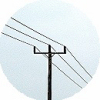 Our electricity supply comes to us from a generating station, by means of power lines. The majority of these are overhead cables, supported by large transmission towers or pylons. The cables emit magnetic and electric fields. Power lines carrying smaller loads to meet local power needs are supported on smaller metal towers or wooden poles. The electric field is proportional to the line voltage, while the magnetic field depends on the load current. Typically, high voltage transmission lines carry high current and therefore give off both high electric and high magnetic fields.