 |
 |
|
 |
 |
About Us | Contact |
|
|
SubstationsExtremely low frequency EMFs index » Overview | Power lines | Substations | Electrical wiring | Electrical appliances
Electric and magnetic fields are generated by the equipment inside the substation or transformer and the cables going in and out. Sometimes substations are interconnected in such a way that high magnetic field levels are created in a wide area, affecting many houses, especially those with small or no front gardens. Again, the only way to know what field levels you are exposed to is to measure them - is it impossible to give an accurate calculation or estimation. Low power substations are found about 150-200 metres apart in a typical urban area. They are often grey metal boxes in a fenced enclosure. Sometimes they are inside brick or plastic structures. They have a 'Danger of Death' yellow sign attached to the fence. This is to warn the public of the danger of electric shocks. They change a high voltage coming into the substation, often 11,000 volts, though it can be higher, into 415/230 volts. Rural areas may have small grey box transformers attached part way up a wooden pole. The bigger the substation, the higher the electromagnetic fields are likely to be and the further away a property has to be, to be in low fields. Measure the fields, it is easy and vital to do so. Why be concerned?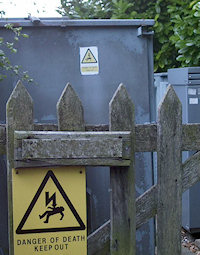 Substations are not hazardous because they are substations. It is because they are surrounded by electromagnetic fields that the equipment and cables they contain produce, that they have to be treated with caution. Measured electromagnetic fields such as those produced by substations have been associated with health effects such as cancer, depression, dementia, infertility, miscarriage, heart problems, etc. For further details see our library article Powerfrequency EMFs and Health. Electromagnetic fields (which are associated with the health problems)There are two types of electromagnetic fields produced by overhead and underground cables and the substation equipment itself; electric fields and magnetic fields. The strength of the electric field depends on the voltage. Electric fields from substation equipment are unlikely to extend beyond the equipment housing, as they are screened by practically all building materials. Magnetic fields are caused by electric current flowing when people use electrical power. For all practical purposes magnetic fields cannot be stopped and will travel through walls as if they were not there. Larger substations are associated with higher EMFs. The nearer they are to a property, the higher the levels of magnetic fields are likely to be inside. EMFs can be measured using a hand-held, easy-to-use meter such as the EMFields-ELF or the smaller MagneMeter available to hire or purchase from EMFields. Building materials and some trees reduce electric fields, but magnetic fields travel through pretty well everything. CablesThere may also be underground cables leading to or away from the transformers. Electric and magnetic fields also come from underground cables. The electric fields will be zero as they are screened by earth, concrete, sand etc. The magnetic fields are very high near to the cable, higher than from overhead cables because they are closer to you. They fall off more rapidly than the fields from overhead wires, because the cables are closer together and cancel out each other's effects more quickly. You are likely to have a cable running underground at the front of your property, which can affect electromagnetic fields at the front of the house, or at the side or back, especially if you have a public footpath by the side of your property. This could give you high levels of electromagnetic fields in the garden. Net and stray currentsHouses, or ground floor or basement flats, with very small or no front garden, may have high magnetic fields in their front rooms from distribution cables running underneath the pavement. In many built up areas the electricity companies often connect neutrals from different substations together, this can produce unpredictable 'net currents' which flow round the system the wrong way and can give rise to high magnetic fields over wide areas (e.g. round 4 or 5 streets). It can create very high magnetic fields in houses, usually with no way of reducing them, as the electricity companies do not believe high magnetic fields are a problem. The ONLY way to find out if this is a problem is to measure the magnetic fields at the house, preferably at a "busy"time - e.g. 8 am or 6 pm. If the electricity company takes readings for you (in some areas this is a possibility), they may not be taking readings at these peak times. If there is a 'net current' in the street, the magnetic field levels will be similar throughout the property, and most of the other nearby houses, not reducing much with distance from the substation. In our surveys about one quarter of the properties can have net current problems. Please see the links to SAGE2 report lower down this page for further detailed information. 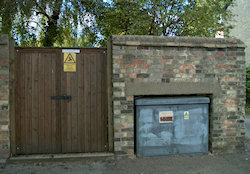 'Stray' currents are due to faults in the neighbourhood electricity system that have transferred on to metal gas and/or water pipes and can be detected by holding the EMF measurement meter close to the pipes where they come into the house. In flats, measure close to all water and gas pipes. Stray currents are surprisingly common and can be stopped, but this is not always easy and there is a cost involved.
Health effectsIn cities, flats, workplaces and sometimes houses can have substations next to, or under the property (in a basement), as part of the building structure. These can produce high magnetic field levels in rooms on the same floor as the substation or in the floor above (Ilonen 2008, Thuroczy 2008). Magnetic fields can also cause computer 'wobble' which can make operators feel ill and is against Health and Safety at Work regulations.
Property valuesSally Sims and Peter Dent of Oxford Brookes University in 2005 published
What you can doRead about the Department of Health led PW SAGE2 report and download and read the full The local electricity board may provide you with a plan of underground cables, to see how close the main cables are to you. They are not always accurate, but their actual position can easily be detected using a powerfrequency field meter, such as the PRO or 3030B, from EMFields. It is possible that the electricity company will only supply plans of cables to a property's owner, so some negotiation may be necessary if you haven't purchased the property yet. 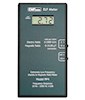 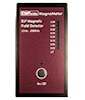 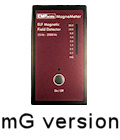 The only way to get a reliable idea of the field from cables is to measure them. It is very difficult to calculate the estimated level because of the possible variability, due to trench size and depth and layout of the cables. For most people, it is where you spend a lot of time relatively unmoving that it is advisable to have low fields. If there is a substation adjacent to the house it is very important to measure the field levels. Until you have done so, put any beds in the room as far as possible from the substation, with the bed-head at the furthest point. Remember the critical precautionary level for magnetic field levels (which cannot be reduced by screening) is below 0.1 microtesla in bedrooms and 0.15 microtesla in play or sitting areas. Ideally, areas in the garden, which are used for play or relaxing should have fields of less than 0.2 microtesla. Hand-held, easy-to-use meters that will accurately measure both electric and magnetic fields such as the EMFields-ELF or magnetic fields such as the MagneMeter (microtesla or mG scales) are available to hire or buy in the UK from EMFields. References1. -
Thuroczy G et al, (2008) Exposure to 50 Hz magnetic field in apartment buildings with built-in transformer stations in Hungary, Radiat Prot Dosimetry. 2008;131(4):469-73. Epub 2008 Jul 30 [View Author's abstract conclusions] [View
on Pubmed]
2. -
Ilonen K et al, (April 2008) Indoor transformer stations as predictors of residential ELF magnetic field exposure, Bioelectromagnetics. 2008 Apr;29(3):213-8 [View Author's abstract conclusions] [View
on Pubmed]
3. P
Sims S, Dent P, (2005) High-voltage Overhead Power Lines and Property Values: A Residential Study in the UK, Urban Studies, Vol. 42, No. 4, 665-694 (2005) [View Author's abstract conclusions]
This page has links to content that requires a .pdf reader such as |


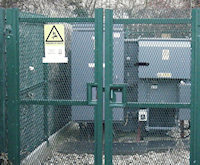 Substations are part of the electricity supply network that enables the widespread use of electricity at home, work, places for education, leisure, commerce, health care, etc. The size of substations can be very variable, depending on whether they serve mainly residential properties, or also commercial and industrial units, etc. Schools and institutions such as hospitals often have their own substation. The purpose of substations is to transform the voltage from long-distance high voltage powerlines to the voltages used to supply our homes.
 a study