06/02/2003 - Mobile phone signals kill off brain cells in rats
Nerve Cell Damage in Mammalian Brain after Exposure to Microwaves from GSM Mobile Phones
Leif G. Salford, Arne E. Brun, Jacob L. Eberhardt, Lars Malmgren, Bertil R.R. Persson
Lund University, the Rausing Laboratory and Lund University Hospital, S-22185, Lund, Sweden.
 This is dramatic confirmation of our worst fears. Over 5 years ago we were writing that heavy mobile phone use caused people to have short term memory problems - indeed it was a joke among some service and installation engineers that they would forget to turn off at the right road and end up in the next village (etc). Then a senior BT engineer developed severe dementia aged only 38 and was eventually retired due to ill health - though BT deny any possibility that it was work related. He had been using an early GSM phone for typically 6 hours per day - sometimes even using two phones, one to each ear, when trying to debug faulty exchanges and data-comms centres. Then we discovered that there was apparently a general increase in early-onset dementias (before the age of 55) in many areas of the UK such that some hospitals were setting up new treatment/management units to help these people cope. This is dramatic confirmation of our worst fears. Over 5 years ago we were writing that heavy mobile phone use caused people to have short term memory problems - indeed it was a joke among some service and installation engineers that they would forget to turn off at the right road and end up in the next village (etc). Then a senior BT engineer developed severe dementia aged only 38 and was eventually retired due to ill health - though BT deny any possibility that it was work related. He had been using an early GSM phone for typically 6 hours per day - sometimes even using two phones, one to each ear, when trying to debug faulty exchanges and data-comms centres. Then we discovered that there was apparently a general increase in early-onset dementias (before the age of 55) in many areas of the UK such that some hospitals were setting up new treatment/management units to help these people cope.
Now we have both a possible mechanism (leakage of large molecules such as albumin through the blood-brain barrier) and direct evidence of neuronal death in rats. This occurred at 2 mW/kg SAR level .... mobile phones are allowed (ICNIRP) to put up to 1000 times this SAR (2000 mW/kg or 2 W/kg) into the user's head! Extensive brain cell death was seen by an exposure level of 20 mW/kg for just one two hour period. All mobile phone use with the phone held next to your ear will cause at least this level of microwave exposure to your brain cells - most phone can put more than 200 mW/kg into your brain cells when they are working.
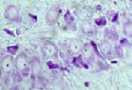
12 to 26 weeks old rats were chosen for these tests (as it is unacceptable to sacrifice children and slice up their brains) because they are comparable to human mobile phone addicted teen-agers with respect to their relative development age. 50 days later they were sacrificed and their brains sectioned and stained. The authors write: "The situation of the growing brain might deserve special concern from the society since biological and maturational processes are particularly vulnerable. The intense use of mobile phones by youngsters is a serious memento. A neuronal damage of the kind, here described, may not have immediately demonstrable consequences, even if repeated. It may, however, in the long run, result in reduced brain reserve capacity that might be unveiled by other later neuronal disease or even the wear and tear of ageing. We can not exclude that after some decades of (often), daily use, a whole generation of users, may suffer negative effects maybe already in their middle age."
Leif Salford said on UK BBC Radio4 "You and Yours" programme on 5th February 2003 that he would not allow his children to use a mobile phone other than in a real emergency and he chooses not to use one other than when he really has to. He said he rated the reality of brain damage as a "probability rather than a possibility".
When neurons die, they are dead. They do not get resurrected. To start with effects are not likely to show up at all, but then 'forgetfulness' is likely to increase so that you need to look more things up again and again so that other neuronal pathways can be created in your brain to remember the information. You will probably have to start to write lists of tasks that you need to do. Eventually a point is reached where catastrophic failure occurs with the rapid onset of significant dementia. There has been some recent brain research that shows that "keeping an active brain" can generate some new brain tissue even into old age. However if you have already developed early brain death it is unlikely that you would be able to be mentally active enough for this to happen.
Is that mobile phone call really worth the risk?
Paper abstract
The possible risks of radio-frequent electromagnetic fields for the human body, is a growing concern for the society. We have earlier shown that weak pulsed microwaves give rise to a significant leakage of albumin through the blood-brain barrier (BBB). Now we have investigated whether a pathological leakage over the BBB might be combined with damage to the neurons. Three groups of each 8 rats were exposed for 2 hours to GSM mobile phone electromagnetic fields of different strengths. We found, and present here for the first time, highly significant (p < 0.002) evidence for neuronal damage in both the cortex, the hippocampus and the basal ganglia in the brains of exposed rats.
Environmental Health Perpectives, doi:10.1289/ehp.6039, 29 January 2003,
Journal of the USA Institute of Environmental Health Sciences
| 




