|
 |
|
 |
 |
About Us | Contact |
|
|
07/02/2005 - Low Height High Power Base Station Scandal
ContentsSummary Summary - [Back to Page Contents]The NRPB have confirmed long-standing Powerwatch claims that many of the base stations that irradiate the public with the highest levels of microwaves are being put up without any need for public or council consultation. These are wall-mounted and lamp-post antennas that come under a "de minimis" planning loophole which basically means if they aren't too visible then the mobile phone operators can just put them up following a 28 day "notice of installation" sent to the local council. Many councils do not even record these on their register of mobile phone base stations. The full expression is "de minimis non curat lex", a Latin phrase that means "the law does not care about very small matters". This shows contempt for public concerns about adverse health effects, as many people who are suffering adverse health effects do not consider being irradiated as "a very small matter". Tenfold Cancer Increase - [Back to Page Contents]A 2004 study in Israel (see study), published in the International Journal of Cancer Prevention, found an increased risk of women developing cancer was 10 times higher in the group of 622 people who lived within 350 metres of a 10 metre high GSM mobile phone mast, compared with 1222 similar people who lived further away from the mast (with similar housing, lifestyles, etc). Other effects have also been reported. Introduction - [Back to Page Contents]Current planning guidance encourages mobile phone Operators to keep mast heights low and to hide antennas on lamp posts and buildings - this effectively exempts them from the planning process. This is the worst possible scenario for trying to limit public exposure to microwave radiation as it brings the antennas close to where people work, rest and sleep. This actually leads towards maximising public exposure. The close proximity to people means that locals are invariably more highly irradiated than they would be from high masts well above the rooftops. The NRPB, who had £66,000 from the Department of Trade and Industry (DTI) via the Mobile Telephone Health Research Committee (MTHR) to investigate the field strength around 20 of microcell base stations, found that they caused higher public exposure to microwaves than the large masts that most people are concerned about. Their results are presented in NRPB Report W62 (View Report). Extraordinarily, they excluded the highest low-height radiating base stations as they claimed that they used too much power to be rightly called a microcell base station! They ignored these low-height higher powered base stations (around 6% of total UK base stations) with the agreement of the UK MTHR: "It was noted that some 2000 of the 32,837 base stations, or around 6%, were radiating more than 5 watts at heights up to 10m. In conjunction with the MTHR project monitors, it was considered whether these transmitters should be included. It was decided that they should not be and that this project should concentrate on the low power sites in order to stay true to its original aim of considering microcells as low-height / low-power transmitters."
NRPB W62 Report
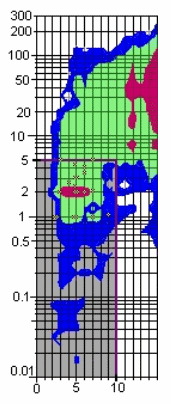
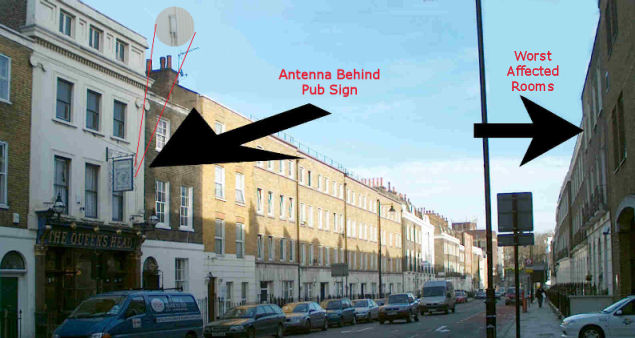
Extract from NRPB W62 Figure 2 This shows the NRPB cohort (10 metres and up to 5 watts) and the 2000 base stations in their database which exceed 5 watts (and transmit up to just over 100 watts) that were ignored. Despite this they found that even the correctly low-powered ones still exposed the public to higher microwave radiation that they get from most large macrocell sites (up to 8.6% of ICNIRP). Now some of the low-height base stations listed in their database and shown on their graph, Figure 2, had output powers up to 100 watts, 20 times higher that the 5 watts allowed in the NRPB analysis. Now, 20 x 8.6 = 172%, so will some of these unmeasured base stations actually exceed the ICNIRP public exposure guidelines? These base stations urgently need measuring under an open public audit process. An example of a too high-powered wall-mounted base station antenna is shown below. This is causing pulsing microwave levels continuously in excess of 6 volts/metre in the bedrooms and living rooms of residential apartments across the road. This particular example is in central London.
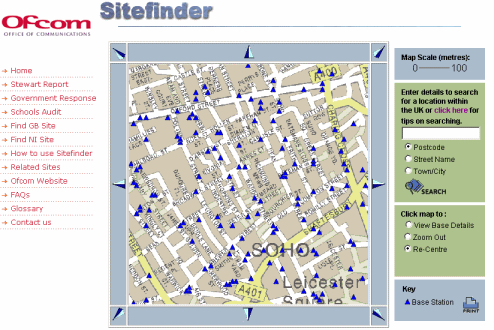
It is not unique. In a random quarter of a square mile around Soho in London we found 94 of the base stations, out of the total of about 150, were 10 metres or under.
Of these 94 none of the low-height ones were H3G, and only T-Mobile had low-height 3G base stations in this area. The analysis (under 10m) was:
7 dBW represents 5 watts radiated power per channel and was the upper cut-off for the NRPB W62 study. 15 dBW (the Orange average) represents 32 watts radiated power per channel - just over 6 times stronger than the ones included in the NRPB study. None of these low-height base stations needed public consultation as they all come under the de-minimis planning loophole. "The Board notes that whilst the planning process applies to macrocells, it does not obviously apply to microcells and picocells. It is important that, as the networks develop, there is a need for clarity in terms of the legal responsibilities and regulations in relation to the installation of microcells and picocells and the availability of information about their deployment."
Executive Summary Paragraph 30, They wrote this because they had discovered some 2000 so-called microcells that had higher power than the NRPB thought was acceptable under the ETSI Standard. Powerwatch has been saying this since 2001 Definitions - [Back to Page Contents]The definition of microcells provided by the Mobile Operators Association (MOA) is: "Microcells provide infill radio coverage and additional capacity where there are high numbers of users within macrocells. The antennas for microcells are mounted at street level, typically on the external walls of existing structures, lamp posts and other street furniture. The antennas are smaller than macrocell antennas and when mounted on existing structures, can often be disguised as building features. Typically, microcells provide radio coverage across smaller distances and are placed 300-1000 metres apart. They have lower outputs than macrocells, usually a few watts."
Mobile Operators Association The industry agreed view as far as Powerwatch is concerned is: "The antennas for macrocells are mounted on ground-based masts, rooftops or other existing structures, at a height that provides a clear view over the surrounding buildings and terrain. The cell radius varies from at least 500 metres up to a maximum of about 35 km. Macro base stations typically have between 2 and 8 channels which can each carry 8 telephone calls - i.e. only about 64 simultaneous calls in any one of the 3 directions from even a major macrocell mast." "Microcells are designed to provide radio "infill" coverage and additional call capacity for high traffic densities in urban and suburban areas to users both outdoors and within buildings. Microcell base station antennas are lower than nearby building rooftops, typically on the external walls of existing structures, lampposts and other street furniture, so coverage area is primarily defined by the street layout. Microcell coverage is 100 to around 500 metres and their antennas are often disguised as building features." The operators have installed high-power macrocell type transmitters at microcell sites. Their antennas often face domestic bedrooms and living rooms just across the street - thus causing the highest microwave irradiation of people - often between 3 and 10 volts/metre. See below for comparisons of what this means. Modern scientific concern has been taken on board by a number of countries when setting guidance for the maximum signals from base stations that members of the public should be subject to. Here is a table of precautionary guidance levels:
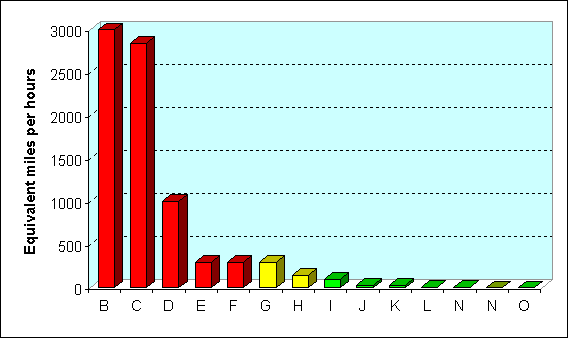
Note that in the UK it is very rare for broadcast radio signals to exceed 1 V/m inside residences, with VHF/UHF ones rarely exceeding 0.05 V/m, being typically less than 0.01 V/m. Mobile phones can work down to less than 0.00003 V/m. As 'volts per metre' is not a unit that most people are familiar with, we have taken the 1998 Salzburg level (J) of 0.6 V/m as being 'equivalent to' a 30 mph vehicle speed limit in residential areas and then scale the other levels relative to this. It is easy to see that the ICNIRP guidance is not at all precautionary in any meaningful sense. Here is the table in graphical form:
The Precautionary Principle and Planning Guidance - [Back to Page Contents]"The precautionary principle covers cases where scientific evidence is insufficient, inconclusive or uncertain, and preliminary scientific evaluation indicates that there are reasonable grounds for concern that the potentially dangerous effects on the environment, human, animal or plant health may be inconsistent with the high level of protection chosen by the EU. The precautionary principle provides a basis for action when science is unable to give a clear answer. Lack of full scientific certainty shall not be used as a reason for postponing cost-effective measures to prevent environmental degradation or danger"
The European Commission Powerwatch, in line with some European Governments, believes that the time is now overdue for a proper precautionary approach regarding human exposure to electromagnetic fields. The UK Health & Safety Executive's guiding principle is "As Low As Reasonably Practicable" (ALARP). "Reasonably practicable" implies that a judgement must be made, balancing the risk itself and the sacrifice involved, when considering measures necessary to avert that risk (whether in money, time, trouble or even the forbidding of the activity). ALARP was the approach recommended by the Independent Expert Group on Mobile Phones (IEGMP) in their 'Stewart Report' published in April 2000: "We recommend that in making decisions about the siting of base stations, planning authorities should have the power to ensure that the RF fields to which the public will be exposed will be kept to the lowest practical levels that will be commensurate with the telecommunications system operating effectively."
Paragraph 1.43, It is worth noting that the recent "Stewart 2 Report" (2005) reaffirms this approach: "The Board believes that the main conclusions reached in the Stewart Report in 2000 still apply today and that a precautionary approach to the use of mobile phone technologies should continue to be adopted."
Executive Summary, Paragraph 19, The UK Government and the Regional Assemblies welcomed the 2000 Stewart Report and said they would adopt its precautionary stance. In fact they completely omitted the "as low as practical" requirement. "Mobile phone operators already keep their RF power outputs to the lowest possible levels commensurate with effective service provision."
Annex paragraph 100, We, and now the NRPB, have clear evidence that this is not the case for many base stations. As this underlying predicate to PPG8 is incorrect, the whole basis of PPG8 is currently flawed. The following is from the Scottish planning guidance: "The IEGMP recommended a precautionary approach, comprising a series of specific measures, to the use of mobile phone technologies until there is more detailed and scientifically robust information on any health effects. The Government's response to the IEGMP report includes acceptance of the recommended precautionary approach."
Paragraph 21, However it only actually requires that base stations comply with ICNIRP exposure guidance. ICNIRP, the International Commission on Non Ionising Radiation Protection, is a largely self-appointed body of industry and regulatory people who, like the UK NRPB, only seem to believe in thermal (heating) effects of microwaves and consequently allow relatively high levels of radiation exposure. In line with the Stewart Report, the UK House of Commons Trade and Industry Committee recommended the following: "The IEGMP recommended a precautionary approach, comprising a series of specific measures, to the use of mobile phone technologies until there is more detailed and scientifically robust information on any health effects. The Government's response to the IEGMP report includes acceptance of the recommended precautionary pproach."
[HC330, N12, 3 April 2001], This has still not been implemented anywhere in the UK. The old fashioned view, which the cellular phone industry and the NRPB cling on to, is that microwaves only cause heating. At high levels microwave radiation does cause heating, which is how microwave ovens work. We cannot consider people as if they were dead slabs of meat with a built-in cooling system (the blood circulation). This completely ignores the fact that we are complex living beings that are exquisitely sensitive to many environmental signals. Leading bioelectromagnetics research investigating possible adverse health effects of microwaves strongly indicates that low levels of pulsing microwave signals affect and stress our essential life processes. Our bodies are remarkably good at coping with occasional 'attacks', but often fail when under the stress of constant low level 'irritation'. The often cited arguments about ionising (= can break a covalent chemical bond) and non-ionising (= too weak to break a covalent bond) are fundamentally flawed. Firstly, during the 'dance' of cellular DNA replication most critical bonds are formed by hydrogen or Van-der-Waal forces that are hundreds of times weaker than covalent bonds. Secondly, there are a number of cell trans-membrane protein signalling mechanisms that are affected by pulsing microwaves, at signal powers vastly below ionising levels, that lead to gene expression relating to cell stress responses and cell growth regulation that are likely to affect cancer incidence and treatment outcomes. Adverse Health Effects - [Back to Page Contents]Although the IEGMP did say that levels below the international guidelines should not cause health problems in the general population, Sir William Stewart later clarified this for the UK Government: "Overall the balance of evidence to date - this is a carefully constructed phrase - suggests that exposure to RF emissions below the national guidelines do not cause adverse health effects to the general population. However, we went on to say that there was now scientific evidence that there may be biological effects occurring at exposures below those guidelines. Biological effects do not necessarily translate into health effects, but neither do they necessarily not translate.
"It is simply not possible to say that there are no potential effects on the human population. It is difficult to talk about the population because populations vary. Antibiotics do a wonderful job for the general population, but there is a subgroup in the population that is allergic to antibiotics; they cannot take them. There is a sub-group in the general population who cannot eat nuts because they are allergic to them. That is why we refer to the general population. The other point is that we mentioned health effects and well-being effects. On the basis of discussions such as those we came to advise on the need for a precautionary approach." Sir William Stewart Several thousand qualified German doctors have signed the "Freiburger Appeal". This states their experience that a wide range of symptoms and conditions have increased in incidence in the last few years and they are convinced it is pulsing microwave pollution from cell-phone systems that are causing this. Problems include: Learning, concentration and behavioural disorders; blood pressure fluctuations; heart rhythm disorders; brain-degenerative diseases and epilepsy; various cancers; headaches and migraines; chronic exhaustion; inner agitation; sleeplessness, disturbed sleep and daytime sleepiness; tinnitus like symptoms; and rashes and redness skin inflammation problems. They call for a reduction in mobile phone base station signals, for education to persuade people only to use their mobile phones in emergencies, and a ban on the use of mobile phones by children. A 2004 study in Israel, published in the International Journal of Cancer Prevention, found an increased risk of women developing cancer was 10 times higher in the group of 622 people who lived within 350 metres of a 10 metre high GSM mobile phone mast, compared with 1222 similar people who lived further away from the mast (with similar housing, lifestyles, etc). The oft-told lie that "we have been exposed to these sorts of signals for more than 100 years without any known effects" needs to be debunked. Firstly the vast majority of the population had very little exposure to microwaves until the mid 1980s and background levels above about 0.1 volts/metre have only occurred in centres of population during the last ten years. There is very little natural radiation in the range 300 MHz to 3000 MHz - in the last few years we have added man-made microwave radiation 1,000,000,000,000,000 times stronger that the natural background levels. Also, the modulation systems used by digital GSM and 3G mobile phone systems, which were only introduced in the mid-1990s, have very much more aggressive signal qualities compared with earlier systems. We have really been exposed to these novel signals for less than ten years - far too short a time to determine if exposure is causing chronic adverse health problems, especially as no long-term scientific studies have been, or are being, are being conducted. I believe that mobile phone system radiation will produce long-term harm to the health of many of us. If we accept that the jury is still out on this question, I also firmly believe that there is a significant part of the population (maybe 5% or 3.5 million people in the UK) that adversely react to low levels of microwave radiation. It stresses them generally and also commonly produces some specific effects, especially disturbed sleep, headaches and chronic fatigue symptoms. People with allergic or idiopathic responses to antibiotics, nuts, pollen, etc, are warned so that they can avoid being exposed. People who react to microwave radiation are being irradiated without any warning or meaningful consultation. We believe this is unacceptable, especially as their irradiation could be greatly and easily reduced by appropriate controls on the mobile phone companies' activities. The Government formally welcomed and accepted the Stewart Report's precautionary approach, but never implemented this requirement. I suggest that a way forward that would provide a reasonable restriction on mast siting that would stand a chance of being upheld in a court of law would be to enforce the Stewart Report's Advice to Government in para 1.43, namely: "We recommend that in making decisions about the siting of base stations, planning authorities should have the power to ensure that the RF fields to which the public will be exposed will be kept to the lowest practical levels that will be commensurate with the telecommunications system operating effectively."
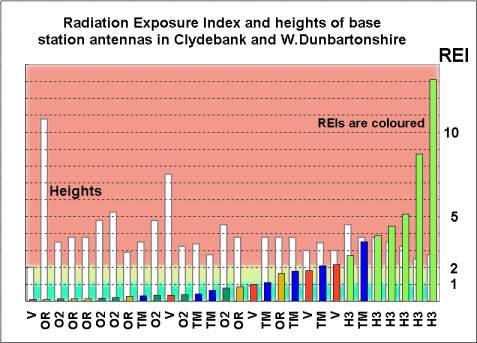
Alasdair Philips, How do we assess for "lowest practical levels"? - [Back to Page Contents]The Stewart Expert Group did spend some time developing and arguing about the need for a "rule of thumb" test for just this purpose. It did not materialise in the final Report, due to practical matters about how to measure "effective height" and also due to industry influence. Powerwatch then proposed such a test (details are on our website) that quickly enables a Radiation Exposure Index (REI) to be calculated, enabling "quick, look-see" comparisons to be made between base stations. Here is the data for Clydebank and Dumbarton using the power and height-above-ground-level data taken from the Radiocommunications Agency Sitefinder website:
Unlike our Soho analysis (or our earlier Basingstoke, Peterborough and Norwich analyses), here we find H3G as the worst offender. For a normal housing estate with a free-standing mast, height "above ground level" (AGL) is fine. This is available on the government's Sitefinder web site. In city areas with high residential buildings, the antenna height should be taken from the floor level in any bedroom or living room from which the antennas can be seen within about 200 metres from the base station. It can be seen that some operators have been far more successful than others at minimising public microwave radiation exposure. The REIs of some of the high masts will increase when other nearby buildings are taken into account. The average REI of the best 50% of base stations is 0.35.
Compare this with the average REI of '3's (H3G) sites in the above graph, which is a REI of 6.3. This means that on average Hutchison's system irradiates the local population in Dumbarton 18 times more strongly than the best 50% of the other local sites of other operators; the REI of their worst mast is 37 times higher than best practice suggests it should be. For one of their base stations in Manchester, Hutchison predict levels that approach half of ICNIRP (i.e. around 30 V/m at 2.1 GHz) at the windows of nearby houses. In our opinion this is inexcusably high for residential exposure, but it is still within current UK Guidance. All sites should be considered individually to see how masts could be located to minimise irradiation of the local population. Generally this will involve locating the antennas as high as possible and ensuring that they avoid and beaming their power into windows of nearby buildings. This page has links to content that requires a .pdf reader such as | |||||||||||||||||||||||||||||||||||||||||||||||||||||||||||||||||||||||||||||||||||||||||||||||||||||||||||||||||||||||||||||||||||||||||


 - Download this article as a pdf (295 KB)