|
 |
|
 |
 |
About Us | Contact |
|
|
12/09/2007 - Mobile Phones not ready for a clean bill of healthThe first MTHR overview summary says that there is still more research required, even though the MTHR studies found little firm evidence of serious problems to human health in short to medium term exposure. INTERPHONE StudiesThe MTHR funded some of the recent INTERPHONE mobile phone usage studies which have been indicating a possibly increase in brain tumours for people that have used their phone for more than 10 years. This disturbing finding has delayed the publication of the INTERPHONE study but the published results have been summarised by Hardell et al this year [1] - The findings of increased risk are for both Acoustic Neuromas (benign tumours), and more importantly gliomas, of which the majority are fatal, many within 24 months of diagnosis. This supports their separate earlier research which also found an increase in tumours for mobile phone users who used their phone for over 10 years [2][3]. Lloyd Morgan (researcher from the US) has worked hard to put the data from the INTERPHONE studies, and a few other independent studies (such as Hardell's) into a more visually intuitive graph, comparing the increased risk of Meningiomas, Acoustic Neuromas and Gliomas:
If this link is real, then there may well be a finite and measurable risk of fatality linked with long-term usage of phones, and highlighting that further research is done is a much needed step in the right direction. MTHR Essex Provocation StudyRecently the Essex provocation study [4] for people with self-assessed Electrical Hypersensitivity was published amid much media attention as finding no supportive evidence that subjective responses to mobile phones or phone base stations are caused by the RF radiation itself. They concluded that the sensitive group are not able to tell whether or not the exposure was real or sham, and that there were no other physiological differences between the groups. Whilst the experimental setup of this setup was largely very good (a fact we covered in July), this is a very misleading summary of the study, which found a non-significant, but fairly consistent increase in symptoms for those in the sensitive group being exposed to a real signal. The authors themselves commented that a sample size of 132 people was required for significance, and only 44 were in their sensitive group. It is reasonable therefore to assume that statistical significance was simply not possible as they were unable to get enough sensitive participants in the study. The graph below compares the symptom responses to real and sham exposure conditions from both the sensitive and control participants: 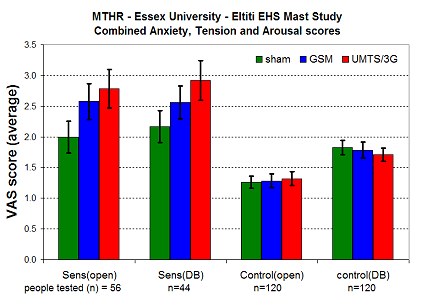 This finding is despite the fact that there was no attempt made to control for and remove nocebo responders (people that believe they are affected but are found not to) from the sensitive group. This indicates that further work, involving a larger and more stringently selected group of sensitive participants, is required to find out whether this apparent increase in adverse health symptoms is real and significant, or whether it disappears as the sample size grows. References:[1] - Hardell L et al, (September 2007) Long-term use of cellular phones and brain tumours: increased risk associated with use for > or =10 years, Occup Environ Med, 64(9):626-32 [2] - Hardell L et al, (October 2006) Tumour risk associated with use of cellular telephones or cordless desktop telephones, World J Surg Oncol, 11;4:74 [3] - Hardell L et al, (February 2006) Pooled analysis of two case-control studies on the use of cellular and cordless telephones and the risk of benign brain tumours diagnosed during 1997-2003, Int J Oncol 28(2):509-18 [4] - Eltiti S et al, (July 2007), Does Short-Term Exposure to Mobile Phone Base Station Signals Increase Symptoms in Individuals who Report Sensitivity to Electromagnetic Fields? A Double-Blind Randomised Provocation Study, Environmental Health Perpectives This page has links to content that requires a .pdf reader such as |