 |
 |
|
 |
 |
About Us | Contact |
|
|
24/06/2008 - Phone Masts linked to suicideThe Daily Express covered a story on the weekend linking the increased number of suicides in Bridgend (Wales) to living proximity to mobile phone base stations. Whilst it would be useful to all to have a sound possible cause for the localised increase in suicide rate, exposures from the base stations are unlikely to be the major factor in driving these young people to suicide. According to the article, masts are placed on average 800 metres away from each home across the country. In Bridgend the victims lived on average only 356 metres away. The national average distance from a new powerful mast (definition of this was unspecified) is a kilometre (we are most doubtful about this - in cities the distance in MUCH less than this - and no source of the 1 km figure is given in the article) while in Bridgend it is, apparently, 540 metres. Three transmitters were within 200 metres, 13 within 400 metres and as many as 22 within 500 metres of victims' homes. Carwyn Jones, 28, who hanged himself last week, was the third young person in his street to commit suicide. It does seem likely that there is a real ecological (physical environmental and/or social/psychosocial/ecomonic) causing this extreme reaction by so many young people. Realistically, however, exposure from a mobile phone basestation is likely to be low by 200 metres away even in full beam, and exposure to microwave frequency radiation from other sources (such as DECT cordless phone units in houses with cordless phones and WiFi - including occupational or classroom exposure) are likely to be far higher. Nor is there any indication in the article whether or not the cases were mobile phone users themselves. Mobile phone use, especially at night, lowers the levels of melatonin and serotonin in the body and these, and related neurotransmitters, are linked to mood and to clinical depression. Also, many young people apparently now sleep with their mobile phone on standby under their pillow - this would be logging on to the local basestation while they are asleep and would be affecting the pineal gland's synthesis of these essential neurotransmitter compounds that control mood and well-being. This sort of tabloid scaremongering is irresponsible and does no-one any favours. If they were going to run the story, the least they should have done would be to also provide a map of the (approximate) suicide locations in relation to the masts, and to have carried out a brief measurement survey to determine the microwave levels from the basestations nearby. They presumably must have had the mapping data in order to say that the victims lived, on average, 354 metres from a basestation whilst the average distance in Bridgend was 540 metres - though they give no source for how they obtained these remarkably "accurate" distances. One figure they quote - "as many as 22 basestations within 500 metres of victims' homes" seems very misleading as they must have repeatedly counted the same base station again and again. It would have been much better to say how many of the victims lived within 500 metres of a basestation, rather than the other way around. They should also have discussed mobile phone and cordless phone use by the youngsters. As it stands it presents no evidence for us to believe that the basestations in Bridgend are a probable risk factor, let alone the primary one. We have obtained information on suicides in England and Wales over the period from 1991 to 2004. This is the period during which most of the mobile phone base stations were errected and commissioned. The Office of National Statistics data is shown in the graph which shows the link to the ONS article. There is not even a hint of an overall rise in suicides over this period - if anything there is a non-significant fall in suicide rate. We feel that this is good evidence that confirms our initial feeling that exposure to microwave signals from bases stations is unlikely to be a significant factor in causing people to take their own life. Regional maps, showing lower than average suicide rates in London and the SE and the highest rates in the Highlands and Islands of Scotland also suggest that there is no causal relationaship between basestations and suicides. Use the ONS link below to download the maps and the full information. 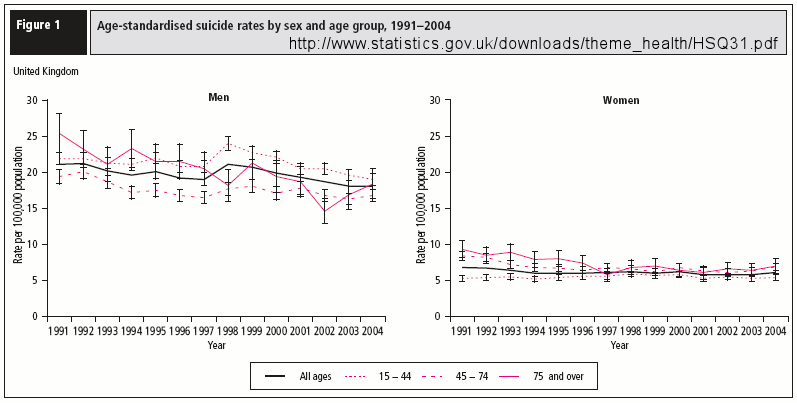 Links
Also in the newsMobile usage damages sleepThe Daily Telegraph recently covered a study finding that "Teenagers who send more than five text messages a day on their mobile phones or make more than five calls are ruining their chances of getting a good night's sleep." This is an interesting finding, but the likely cause is unclear due a number of risk factors. Aside from electromagnetic field exposure from the phone itself, the authors identified two other key elements: those who often used their phones were more likely to take drinks designed to make them feel more alert during the day, and those who used their phones the most appeared to have a different, more frantic lifestyle than other teenagers. They also said that young people felt a "pressure" to be at the end of their phones "around the clock", the stress of which led them to take up smoking or drinking. So whilst the sleep issues may be directly related to the mobile phone usage, it is alo may simply be a proxy for some other aspect of modern lifestyle that is detrimental to sleep quality. It would be useful for the work to be replicated with an attempt to minimise the other confounders.
This page has links to content that requires a .pdf reader such as |


