 |
 |
|
 |
 |
About Us | Contact |
|
|
To pulse (Powerwatch) or not to pulse(MTHR and Airwave)17 July 2003 update to this page - latest from NRPB/MTHR on TETRA The resulting signal from detecting the TETRA base station signal using a simple non-linear diode-like device will in fact depend on the time-constants inherent in the diode and the circuits around it. In practice these will almost certainly prevent one from seeing oscillations at 400 MHz, i.e. a rectified 400 MHz RF signal. (a) With a typical AM radio responding circuit, the diode could follow the ~18 kHz audio variations in the emitted power, as shown in Figure 7 of the AGNIR TETRA Report Technical Annex, so the demodulated audio signal would look like the image below. 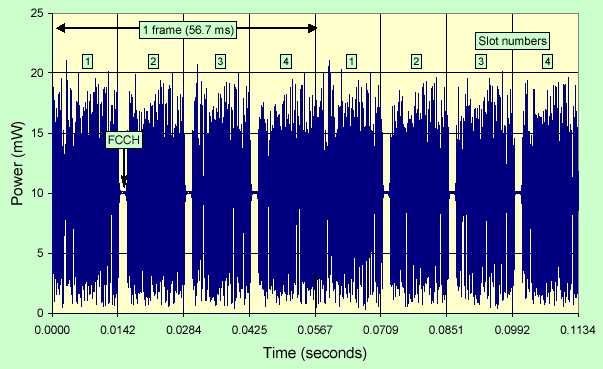 Figure 7 (from NRPB TETRA Report page 60) Power variations in the modulated signal from a TETRA base station over two complete TDMA cycles (b) With a longer time constant, the signal would get to a peak but could not decay to the next trough. So the demodulated signal would approximately follow the peak envelope of the ~18 kHz variations, but would fall periodically to the value marked FCCH in the Figure. (c) With a still longer time constant, the signal would not be able to fall to to this and one would see an essentially constant DC signal which is what you would get if you average it over the 6 minutes recommended by the ICNIRP thermally based exposure guidelines - and this is why the NRPB, Airwave and the MTHR claim the TETRA base station signal does not pulse. The Acoustimeter (available from EMFields) lets you hear the information described above as (a) and (b), and we say this is pulsing. This has been a very public disagreement, especially regarding TETRA masts. Some of this is documented elsewhere on this web site. This note is, of necessity, very technical in places. There are a number of separate instances here, that are dealt with later:
As regards the definition of "pulsing" in the communications industry, we refer to: Chapter 25 ("Baseband Signalling and Pulse Shaping") states: "Baseband signalling and pulse shaping refers to the way in which a group of source bits is mapped to a baseband transmitted pulse." The simplest system is "binary pulse amplitude modulation" (PAM)... it continues ... "Another example of a set of orthogonal pulse shapes for m=2bits/T ... ... the spectrum is, therefore, spread across a much larger band than the smallest required for reliable transmission, assuming a data rate of T/2. This type of signalling is referred to as spread spectrum." "The current IS-95 air interface uses an extension of this signalling method in which groups of 6 bits are mapped to 64 orthogonal pulse shapes with as many as 63 transitions during a symbol. A constant amplitude pulse is appropriate for a fast fading environment with noncoherent detection." That last sentence is MOST definitive regarding the need for a pulse to even have ANY amplitude modulation (i.e. it does not need to!), let alone the requirement to switch the RF carrier on and off in the way that Challis et al insist is a necessary requirement of pulsing. This is an industry source book that clearly shows that Professor Challis' and Airwave's views are misguided, out of date, thinking, not only for the Powerwatch "common sense view" of what pulsing is, but also what the cellular communications industry really understands as pulsing. Using the Challis et al description of pulsing would actually deny that humans have a blood pressure pulse as the blood pressure does not drop to zero between peaks. There are increasing reports of adverse health effects from people living near to mobile phone base stations (BS). Common complaints are sleep disruption, headaches, and fatigue. These include a number of regular GSM phone users who had no related health problems until a BS was installed close to their house. The signal characteristics of digital base station transmissions are very different from the radio and TV signals that people have been chronically exposed to over the last 50 years. We have developed a receiver (A-COM or Acousti-COM) that monitors the amplitude modulation of the totality of RF from about 20 MHz to about 5 GHz, both aurally on a built-in loudspeaker and visibly on an external oscilloscope. A GSM base station will usually dominate the amplitude modulated RF environment within 1000 metres and the low frequency (2-2000 Hz) sharp-edged modulation is new to human experience. At night when call traffic stops, the pulsing often has a prominent 4 Hz component, however I have noted that different UK Operators' BS have identifiable differences. DECT cordless units that transmit signals 24-7, even when the phone is not in use, can also dominate inside houses. Even the 3G and TETRA CDMA based base stations produce significant amplitude modulation which can be heard as a very raucous hissing sound. There are signal qualities in base station emissions that have not yet been investigated and Powerwatch is concerned that the various research projects around the world are not adequately assessing the nature and frequency content of base station amplitude modulation. Alasdair Philips was part of a research funding bid involving three UK universities to the UK MTHR (Chaired by Professor Challis), but it was refused with one of the reasons being that they did not approve of our proposed investigations into pulsing. The signals from base stations differ between systems on a gross level (e.g. the USA NADC uses 50 Hz and GSM uses 217 Hz basic time-frames) and more subtle levels (in control channel and multi-frame timing). The graph below shows the signal from a typical GSM BS with a control channel (BCCH) and 4 traffic channels (TCH). 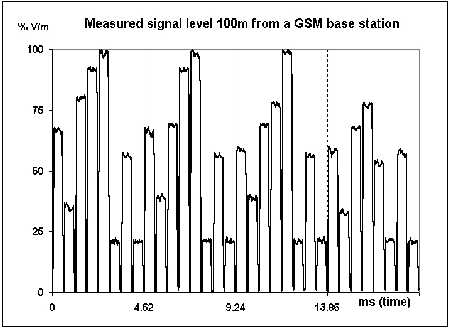 With no call traffic the station emits a continuous series of 0.58ms (millisecond) pulses at about the 20% level in the graph (about 0.8 V/m in this case) separated by 30us (microsecond) guard periods, with multi-frame bursts at 4 Hz. The call traffic channels synchronously add to the amplitude, dependent on the number of active time slots and adaptive power control. The phase modulation within the GSM slots does not produce significant amplitude modulation, however 3G and TETRA phase modulations do produce significant levels of 2-20 kHz amplitude modulation due to their regular discontinuous jumps in phase. The guard periods produce 100% modulation at 1734 Hz, quite close to the proton resonance frequency in water in the Earth's geomagnetic field. This manifests as a loud high-pitched whistle and is unique to BS, as GSM handsets only produce pulses at 217 Hz and below. This may be a real reason that people have different adverse health effects from base stations emissions than from mobile phone handsets which do not emit this high pitched whistle at 1734 Hz. It has been pointed out [1] that, due to battery currents, handsets also produce real extremely low frequency (ELF) magnetic field pulses of several microtesla inside the user's head - so simulated exposure just using pulsed RF is not adequate to test the bio-effects of handset use. These ELF pulses are at frequencies similar to endogenous electrical frequencies within the human body and so may well interfere with normal functioning. We wish to highlight that chronic exposure to BS signals is quite different from exposure to a distant handset - the qualities of the signals vary significantly and future research needs to address this. For the specific instances listed at the top of this article:
Are we "Off the wall" or "beyond the pale"? - we don't think so - have a look at the NRPB/MTHR volunteer exposure specification document[2]. Please make sure you read right to the end of the document, including the waveform diagrams. Just who is pulling the strings of those 'experts' who claim these things do not pulse? Research funds, good salary, nice pension, high status? Smooth ride for the cellular phone industry? References: This article was written by Alasdair Philips, Director of Powerwatch, on 5th July 2003. This page has links to content that requires a .pdf reader such as |


