|
 |
|
 |
 |
About Us | Contact |
|
|
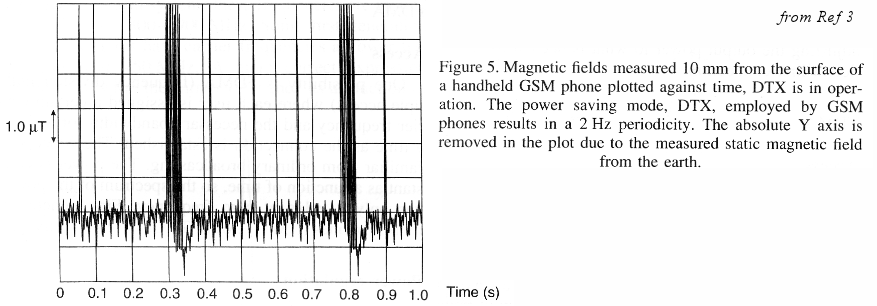
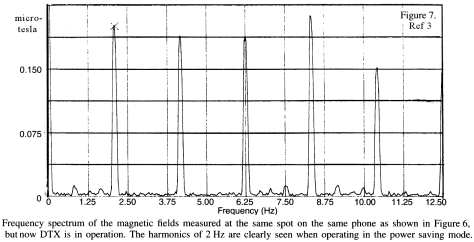
08/06/2007 - Mobile Phone HeadachesA recent double-blind provocation study from Norway has tested 17 people that claim to get headaches from Mobile Phones and have found that there is no difference between the RF and sham sessions [1]. There are, however, some potentially important flaws.There is a very thorough response from the authors to this article at the bottom of the page, please read this as well as our piece. Study FlawsFirstly, the RF exposure itself was not a true representation of total exposure to EMFs from using a GSM handset. The paper does state "RF exposures", but the title does not, and the paper is being widely reported as showing that it is unlikely that mobile phone use causes/triggers headches even in people who claim they do. However, a GSM mobile phone does not only emit a 217 Hz pulsing RF carrier signal. It also generates real extremely low frequency (ELF) and very low frequency (VLF) magnetic fields. These were not present in the tests carried out in this research. Also, the antennas used were mobile phone base station ones located 85mm from the side of the head. This represents a very different RF field pattern and energy levels than are present in the very-near-field situation when holding a modern mobile phone with in-built antenna right next to a user's head. Also, it appears that the 217 Hz data-frame-burst signals were not carrying any voice modulation signals which may, or may not, be relevant but could easily have been implemented to be as realistic as possible. Ten years ago it was shown that at the side of a head 10mm from the surface of a standard GSM phone handset real ELF magnetic fields (due to current surges from the battery) have been measured as being over 6 microtesla [2][3]. These pulse at the same 217 Hz (et al, see below) frequency as the 217 Hz RF pulses, but the levels are quite high for ELF magnetic fields and may either be acting as the main trigger source of the headaches or acting synergistically in combination with the RF pulses.
Not only were these 217 Hz ELF magnetic field pulses missing, but also all the lower frequency components of both the RF and ELF pulsing was missing from the test signals used. These are due to the GSM Discontinuous Transmission (DTX) feature which reduces the number of actually transmitted pulses from the handset to the minimum necessary to handle the conversation. This introduces both RF and real ELF magnetic field pulsing at 2, 4, 6, 8, 10, 12, 14 and 16 Hz, right across the frequency spectrum of real human brain waves [3]. Surely, because these are actually in the range of normal brain-wave frequencies, they are reasonable contenders for being responsible for being a causal factor in headaches? Why leave them out from the experiment?
As these real ELF magnetic fields, typical levels and their frequencies have been in the literature for at least 10 years, it is most disappointing that the researchers didn't include them. It is not clear what real world situation their testing exposure actually simulated. The next, and what we see as a very significant flaw in this paper, is the people that were excluded due to lack of suitability: "People with symptoms when using ordinary phones, visual display terminals or when being in the vicinity of other electric devices, i.e. indicating a general hypersensitivity to electromagnetic fields, were excluded." It is quite possible that those with more severe reactions may well fall into this category, and we do not see this as justification from excluding them from the trial -- shielding the room from other electromagnetic fields (which they did) should deal with the confounders sufficiently for the purposes of the trial. Lastly, and also on the point of exclusions, it seems unjustified to entirely exclude people with greater than 2 headaches per week where the cause of their headaches was unknown. It is quite reasonable to suggest that these headaches may be from a number of other exposures (or non-exposures, for example stress), but it is also reasonable to suggest that these people are reacting to other people using their phones and the attribution had not been made. That said, because of the risk that the headaches are related to totally separate causes, it would not be justifiable to include them in the main analysis. It would however have been interesting to see them analysed as a subgroup, though it must also be accepted that (considering the size of the main group) there may not have been a big enough sample size to analyse - in this case the exclusion would be justified and not a study flaw. ConclusionsAside from these flaws, there were still 17 people left who claimed to have very real effects from using mobile phones, and there can be no doubt that the study did not find an association with the RF exposure that they were exposed to - in fact, it ended up finding a non-significant increased number of headaches from the sham exposure. There is a real risk that the most sensitive people are likely to have been excluded, and there is also a very strong risk that the exposure was too dissimilar to the complex RF and ELF magnetic field exposure from a real a mobile phone to cause the effect, and these are serious confounders. It is also appropriate to suggest that the vast majority of those left in the study who took part may well have had their headaches caused by a nocebo response. It is still important to note that the perceived exposure both found the participants were able to identify both the RF exposure, and the side of exposure more often than not, though these findings were not statistically significant (P = 0.27 and P = 0.67). It therefore appears very important to have a larger sample of participants in future tests (17 is really not enough for statistical significance unless the data correlation is particularly striking) and see if this recognition becomes statistically significant or more likely to be an artefact. It is also vital, that when future studies attempt to study if mobile phone use can cause or trigger headaches, that real mobile phone signals are used and that the RF and ELF fields used closely represent normal reality. References[1] Oftedal G, Straume A et al (2007), "Mobile phone headache: a double blind, sham-controlled provocation study", Cephalalgia 2007 May;27(5):447-55. Epub 2007 Mar 14 [View Abstract] Follow UpFollowing correspondence between ourselves and the primary author of the study, Gunnhild Oftedal, we now have a very comprehensive response from the authors to our commentary. We are currently in further communication with the authors of the study over the points they have raised, and will publish our response in due course. [View response in full (.pdf)] This page has links to content that requires a .pdf reader such as |